
Mitsubishi’s New Pajero Is Real Ladder-Frame Iron
Mitsubishi just built the honest ladder-frame Pajero everyone claims they want; then parked it on the wrong side of the Pacific.
Mitsubishi just built something to take the fight against the Ford Everest and Land Cruiser Prado.
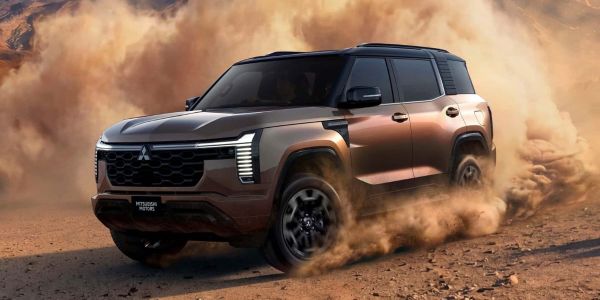
I’m not talking about another soft-roader with black cladding and a “Trail” badge. I’m talking about a body-on-frame flagship with Super Select hardware, diesel torque that actually shows up, and clearance numbers that weren’t dreamed up in a marketing cabin. The new Pajero is real iron.
What actually rolled out
Underneath, Mitsubishi went back to the thing that made this badge matter: a highly rigid ladder frame paired with a double-wishbone front and a newly developed five-link rigid rear axle. Not another monocoque pretending to be a truck. Official press lists a 2.4-liter clean diesel with a single variable-geometry turbo, 480 Nm (354 lb-ft) of torque (470 Nm / 347 lb-ft on select specs), and a new eight-speed automatic. 1
Aussie coverage pins power at 150 kW (201 hp) and confirms that torque bump over the Triton donor. 2 You also get Super Select 4WD-II with 2H / 4H / 4HLc / 4LLc, plus S-AWC tying AYC, stability, and ABS into one brain, and seven drive modes from Eco to Rock.
Geometry from Mitsubishi (20-inch tire specs): 230 mm (9.1 in) ground clearance, 30.4° approach, 22.6° ramp breakover, 25.8° departure. That’s going to save you when rocks are part of the equation.
Size and seating reality check vs Prado/Everest/Tank 500
Dimensions: 4,920 mm (193.7 in) long, 1,925 mm (75.8 in) wide, up to 1,910 mm (75.2 in) tall, on a 2,870 mm (113.0 in) wheelbase. Paul Tan slots it right next to GWM Tank 500, Ford Everest, and Toyota Land Cruiser Prado for size; and carsales notes it’s a hair more compact than Prado in length and width while stretching the wheelbase slightly past Prado’s 2,850 mm (112.2 in) span. 3 2
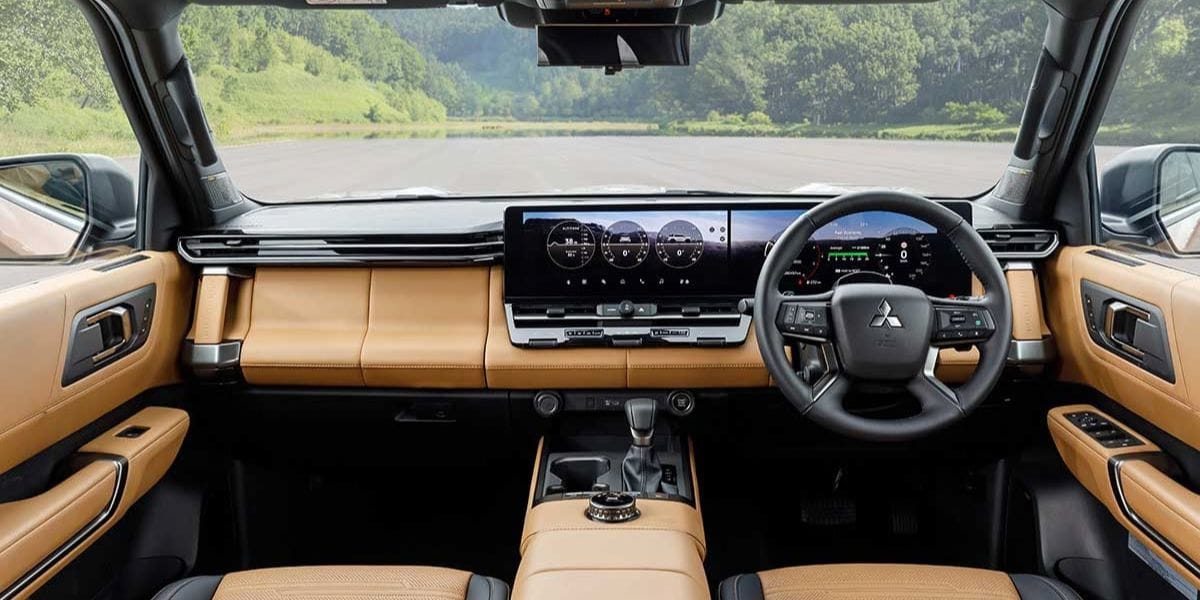
Inside: three rows, seven seats. Second row slides 150 mm (5.9 in) and tumbles for third-row access; Mitsubishi claims adults can actually live back there. I’m not calling it a lounge until we sit in it, but the packaging intent is clear. A family hauler that still low-ranges, not a two-row trail toy with a cargo shelf pretending to be a seat.
Why the spare-tire-on-tailgate icon is gone
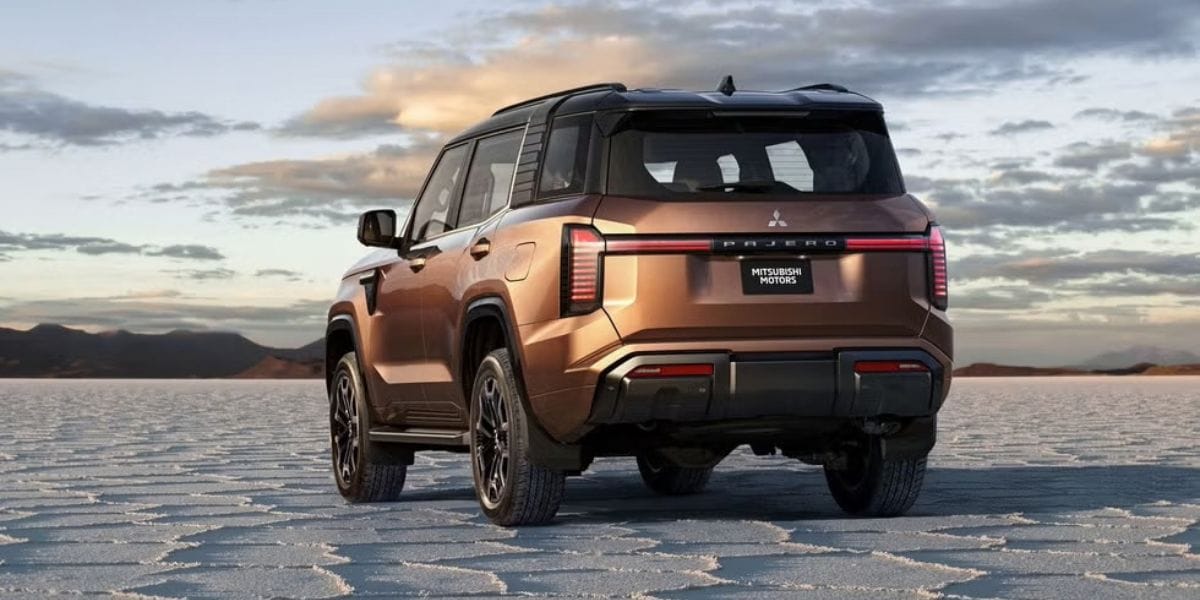
Yeah, I see it too. The rear-mounted spare was the Pajero silhouette for a generation. It’s gone. Official design language replaces it with a hexagonal rear motif that “reinterprets” the old spare (Mitsubishi’s words) and carsales confirms the tire now lives under the body behind a conventional top-hinged liftgate. 1 2
Product chief Kunitoshi Itagaki has told Australian media the change followed global customer feedback: easier hatch access in tight parking, cleaner rear for loading and hitching. I get the pragmatism. I also feel the little betrayal every time I look at the back without that round badge of intent. Designers left a hexagon so we remember what used to hang there. Cute. Still not the same.
Global rollout vs the US/Montero timeline
Built in Thailand. First market: Thailand. Japan and Australia follow in fiscal 2026 (April 2026–March 2027), then roughly 100 countries from fiscal 2027—ASEAN, Latin America, Middle East on the list. Footnote from Mitsubishi itself: the nameplate is Montero in some markets. 1
The United States? Official MMNA line is blunt: no decision on a U.S. introduction, even as the global return gets applause. 4 Dealer-show gossip earlier in 2026 floated a North American Montero around ~2030. Treat that as a spicy rumor.
What this means for the “compact trucks the US is missing” conversation
This Pajero is Triton-adjacent—ladder frame, diesel, Super Select—the same family of midsize body-on-frame hardware that Midwestern friends keep asking for while staring at Ranger/Tacoma lots and wondering why the matching SUV never shows up with low range and honesty.
Every time a Triton-based wagon lands in Thailand and Australia first, it sharpens the same argument: the U.S. isn’t short on interest in compact-adjacent trucks and truck-based SUVs. We’re short on product. Outlander Sport isn’t a substitute. A maybe-Montero after 2030 isn’t a substitute either. It’s a calendar tease.
Early aftermarket and overland implications
Ladder frame plus a five-link solid rear axle is catnip for the overland crowd; mounts, armor, and suspension work that unibody soft-roaders fight you on. Sharing DNA with Triton/L200 should mean a faster parts conversation once the aftermarket maps the differences (wheelbase is shorter than Triton’s; carsales says only the front section and front floor are shared).
The underbody spare changes the game, though. You’re not hanging a jerry can off a swing-out. You’re thinking undercarriage protection, carrier kits, and how a roof or hitch setup replaces the visual and practical role that rear-mounted spare used to play. Early adopters outside North America will write the playbook. U.S. shop owners get to watch—and wait.
Sources
Written by